
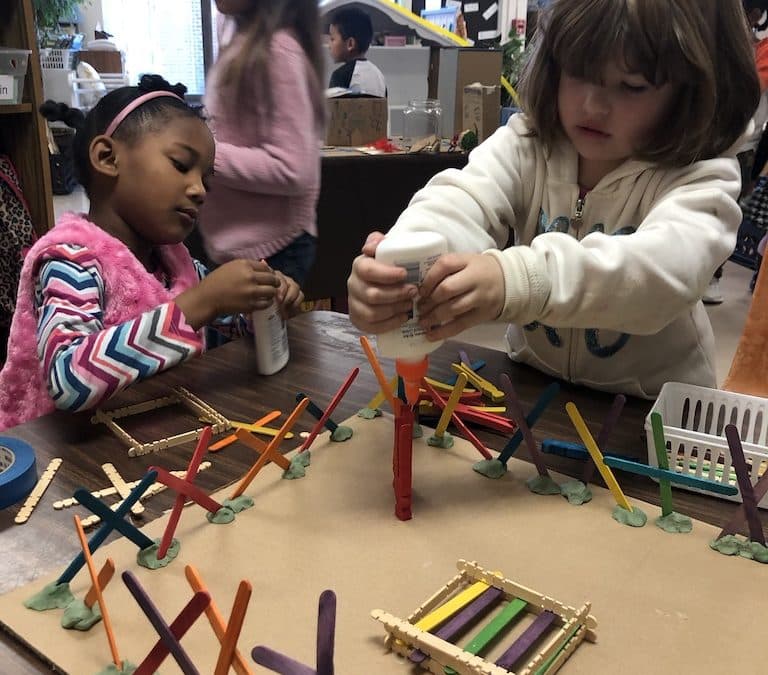
The school is on a busy road. A chain link fence separates the playground from the traffic, and the kindergarteners play without ever thinking about it except when an errant ball flies over it and it has to be retrieved. But now there is a big hole in the fence where a car slammed into it. The teachers forbid the children to play on that side of the playground. At first the children accept that they will have to wait a few days to play there, because the teachers have promised that the fence would be fixed soon. But as the days pass, the hole persists and the children become impatient. Here is a turning point in the story, a place where the children could learn that they have a voice in this community and explore how they can use it to make something good happen…or they could learn that, in yet one more way, they are helpless in the face of adult decisions. Fortunately, their teacher chooses to pursue the first option. She asks the children what they would like to do about their feelings of frustration. The children propose to write a letter to the school administrator requesting that she ask the maintenance crew to fix the fence soon. They think if she knows why the children feel this is a time sensitive matter she will prioritize the repairs, so they make sure to include their wishes in the letter. They also think they can help the maintenance crew know how to fix the fence so it will be stronger. So they collaborate to write the letter and deliver it to the principal. While they wait for a response, they go about drawing plans and constructing fences to help the maintenance workers with the repairs.
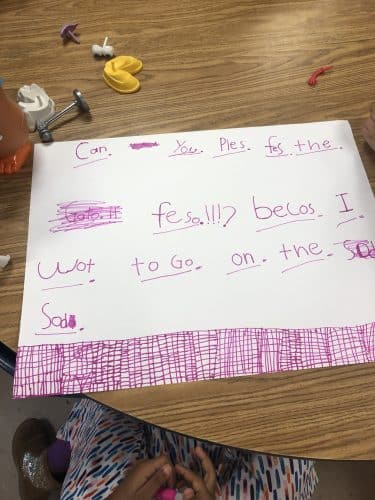
The letter requesting that the fence be fixed because “we want to go on the slide.”
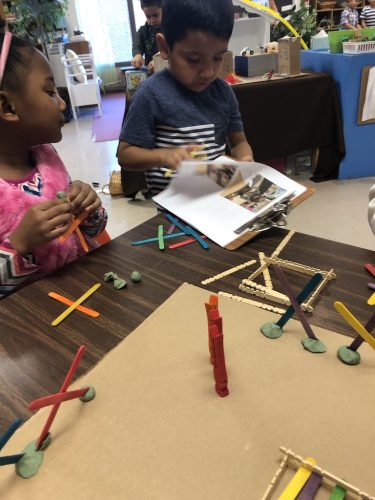
As they work on the “demo” fence for the maintenance workers, children refer to the documentation of previous days’ work.
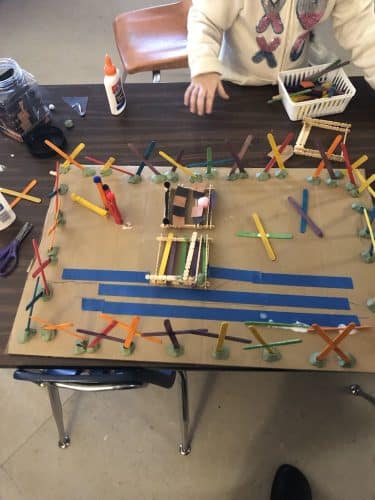
The model fence, ready to help the maintenance crew with the fence repairs
This is a story of community, participation, speaking truth to power, a sense of agency, and democracy in a class of five-year-olds in a public kindergarten. I daresay much of the rest of their education will not be inviting them into such rich participation; this was a singular experience with a remarkable teacher. But I do believe that this experience, and others like it during that school year, had to have an affect on the way the children though and felt about their place as citizens in their community going forward.
In a democratic society, participation is expected and necessary. Here in the United States, we are, at this moment, living the consequences of educating a populace that may know it should participate but lacks the knowledge to do so in a way that will benefit itself. Why is this? Why did so many people in the US, people with strongly felt morals, elect immorality? Why did people who value self-determination along with strong communities elect division and coercion? Why did people connect to the anti-intellectual culture that has been espoused in today’s politics? Why is it difficult for people to see that power has a reason to keep them in the dark? And why is an interrogator of early childhood education broaching a political topic?
First, education is political. We can’t escape that. And second, education has everything to do with the evolution of the populace that chose all of the above. A narrow perspective on participation and on one’s own potential power necessitates reliance on someone else’s point of view. The knowledge of self, the ability to apply logic and discern what doesn’t make sense, and the willingness/ability to engage in critical thinking can serve to inoculate people against the sway of predatory personalities who want to take advantage of our penchant to believe whatever we are told. If people are to find the real-time self-education that such knowledge requires worth the effort, they will have to be acquainted with the sense of agency that participation can bring. We have educated a populace who do not know that sense of agency. Why would they? Our education system has long privileged compliance and superficial understanding.
Children are born researchers. Babies and toddlers follow their curiosity with abandon. The disposition toward inquiry is their birthright, and it grows continually until we “school” it out of them. From the day they enter the school system, many children are taught to accept what those in authority tell them, whether it makes sense to them or not. If they are supported as thinking beings as their interests become more academic and as they enter a larger world, they will understand and embrace the pleasure of participation in complex learning. But if not, and they don’t grow up enjoying the deep pleasure of cognitive engagement, they may resist going there. Their curiosity becomes “What does the teacher want?” Their work becomes “learn it for the test.” Their success becomes steps on a ladder toward college admission. My husband teaches human anatomy to college students. He has observed that all many of his students seem to want is a clear blueprint for what will be on the test. If he tries to incorporate generative or analytical exercises, they complain to the college administration. They are no longer open to the pleasure that intellectual engagement can bring. For them, school is not supposed to be about feeding their intellect. Such things don’t feel safe, because they can’t know what the teacher wants if he is engaging in inquiry alongside them. The education system hijacked their intellects. The cynic in me says that this is intentional. A well-educated populace is not a compliant one. It’s harder to manipulate them.
We need a different paradigm for education at scale. This we have known for decades. We have models for how it can be done. It requires a different image of the learner and a different image of the teacher. Education in this country is both a cause of and an antidote to the precarious perch on which our democratic experiment balances. For so many to be so apathetic to their right and obligation to participate fully that they vote without understanding what is at stake points to systemic problems in our education system. When pedagogy becomes nothing more than preparing for tests, when educators sit comfortably in agreement that teaching means telling, controlling, and restricting and that learning is about compliance and memorization, we can expect that the result will be a populace with low expectations of school and learning. When inquiry, creativity, and thinking all take a back seat to memorization and preparing for statewide tests, students are at risk of growing up without the disposition or skills to participate in inquiry, to think logically for themselves, to seek truth, and to juxtapose what they are told with what actually is. This is, at least in part, how we have landed here, with people willing to believe without thinking and to assume that their leaders have good intentions because they say they do.
Education may be responsible for other reasons for lack of voluntary civic participation, as well. For example, if all of a person’s education were transactional (pass this test so you can go to the next grade) in an atmosphere of compliance, he may never have cultivated critical thinking skills, and he may not understand the issues or be able to parse truth from deception. What if our education systems were, like that of Reggio Emilia, based on the participation of all in the learning community: children, teachers, families, and the citizens of larger community, but starting with the children? What if children could grow up feeling like the full citizens of their school and community that they are, able to experience the multitudes of perspectives they encounter with both generosity and a critical mind?
We who see this have a responsibility to do something, but what? For one thing, we can consider our image of participation, in school and in society. A sense of belonging is a child’s right…belonging to her family, to her class, her school, her community, and the world. That sense of belonging is tied to a child’s participation. She is invited to collaborate with friends in inquiry; she finds her voice and expresses her ideas in dialogue; friends listen and respond; she encounters perspectives different from hers and considers those ideas in the context of her own. Her participation in the life of the classroom is an identity-creator. The child thinks, “I belong here. I have ideas, and my friends and adults want to hear them. I have value as a member of this group, and the group is there for me.” This is empowering and confidence-building. It feels good, so the child participates more.
Let’s consider what a teacher might do to privilege participation in the classroom. For example, what an educator does with questions can either encourage or discourage children’s participation. A question’s usefulness can depend on whether its answer is already known. Children tend to recognize when a teacher asks a question that she already knows the answer to. In doing so, she risks chasing children’s curiosity away. If the children know that the teacher only asks questions to hear a specific answer, their motivation tends to come from a desire to be “right” and please the teacher. They find no reason to engage further with the question. Why should they when the adult is going to tell them the right answer if they don’t guess it? In this way, the children are not full participants in the process.
When, instead, the questions come from the children, expressed either verbally or indirectly through their play and investigation, and the teacher engages with them to explore the question (notice I did not say “answer” the question), a number of things happen. The children discover that generating and entertaining questions brings them pleasure, so they ask. They learn that what they think matters to the teacher they love and to their friends, so they think. They exercise the muscles required for inquiry and grit. As they engage in dialogue with classmates, they encounter opinions and perspectives different from their own. They learn to experience cognitive conflict without falling into emotional conflict. They learn the power and pleasure of full participation. And they learn that all voices matter…which is a value intrinsic to democracy.
The teacher who recognizes this is intentional with the questions she asks and mindful of not answering questions in a way that denies children the opportunity to investigate. In addition, the thinking teacher has questions of her own, including questions about the children’s questions. The way that she addresses these questions is by setting intentions (e.g., “I want to understand about the children’s relationship with the old tree in our schoolyard”), by listening to children’s conversations and observing their play and representation, by offering provocations and making hypotheses, by documenting and studying documentation, and by entering into dialogue with colleagues. She knows that the process of her research is delicate. If she forgets that it is the children’s intent and understanding that is primary, if she slips and lets her own agenda interfere with the children’s participation, she will lose contact with the children’s questions and intent.
When the thinking teacher values children’s participation as the path to intellectual growth, she will solicit and entertain and document children’s questions. She will honor all voices, regardless of whether the children’s theories are correct or are what she expected. She will accompany children in their research, offering tools, materials, and techniques as needed and challenges as progress in the research warrants them. When children disengage from their research, the thinking teacher wants to know why, and she will use what she learns from this experience the next time children initiate a project.
Now, with a consequential election on the horizon, American educators have a multi-faceted opportunity and responsibility. As citizens we must value our own participation and vote. As educators, we must be thoughtful about how what we do has affected and will affect the participation of the youngest citizens in the democratic process. Do they know what participation feels like? Have they experienced how it makes them feel? Is belonging a curricular core? It is not enough to know a definition for democracy; do they live life in their community as full participants, thinking critically, asking questions, seeking truth, and welcoming other perspectives?
The real safeguard of democracy is education. — Franklin D. Roosevelt