

We find ourselves today in a sea of conflict, fed by intentional othering and motivated by fear. Some are so afraid they will be left out that they wrap narrow affiliations around themselves and create their identities within those narrow bonds (powell and Menendian, 2024). It’s a limiting way to exist, in my opinion. And not at all how we are meant to exist. We are born looking for a face. From birth, we seek relationships and belonging. Belonging is our birthright. It brings us joy and security. From a secure foundation in which we feel we belong…first to family, then to community…we are able to explore and “dare greatly” in the world, to quote Brené Brown. The insecurity experienced when we are made to feel that we do not belong shrinks our world, and we want to avoid it. Why, then, would we deny a sense of belonging to others? Why, as we grow, do we come to practice othering as a path to belonging?
At certain cognitive developmental stages, it makes sense. As a former teacher at a girls’ school, year after year, I witnessed children begin to exclude others as a means to belong at the same time they became able to classify based not only on the attributes objects have but also on the attributes they do not have. Their social classification was no exception. Children looked for ways in which some were different from them and found that mustering support from friends-like-them to exclude the “different” gave them an enhanced sense of belonging. In response, teachers clamped down on exclusion by warning, establishing rules, punishing, and banning the “clubs” the girls were driven to form. It didn’t work. The attempt started in kindergarten and continued into middle school and high school, at which point othering was honed to an art. My theories around the phenomenon were that the excluders were looking for a secure sense of belonging and they hadn’t received support to find a way out of the five-and-a-half-year-old state of dichotomous classification of others. My action research questions: What can we do to create and preserve a strong enough sense of belonging in all the children? If we are successful, will the children still associate exclusion with belonging as they do now? Would children learn to invite instead of exclude as their thinking matures?
In dialogue with those research questions, we set up many small systems to guide us in the daily life of the classroom. We wanted to help the children become visible to each other. We did things like turn children toward each other if there was conflict or if a child got hurt physically or emotionally. We invited them to ask the injured child, “Are you OK?” and “What do you need to feel better?” Perhaps a drink of water or a pat on the back or a friend to sit with? We tried to take shame out of the equation when there was conflict in which one child hurt another; rather, we emphasized repair of the relationship. This small system was a daily part of our life in the classroom together. We also set conditions for children to know each other by privileging collaboration and setting up spaces that allowed children to face each other and that encouraged conversation.
Another small system to help children know each other was the birthday project. Each month in which there were birthdays, we invited the birthday girls’ friends to consider what they might like for a present. The project often led to deep investigations into who an individual really was. One project: a series of child-made boxes mounted on a board with 3D models of things the children thought the birthday girls would like. Another, for a child who loved horses, a “life-sized” clay horse. One year a small group set out to learn what the birthday girls’ favorite animals were. They studied those animals through drawing and created large posters with 2 dimensional representations and photographs of 3 dimensional sculptures of the animals. The teachers’ role in these projects was to ask, “What shall we make for the November birthdays?”, facilitate the conversations that ensued, and offer support when needed as the children worked on their plans.
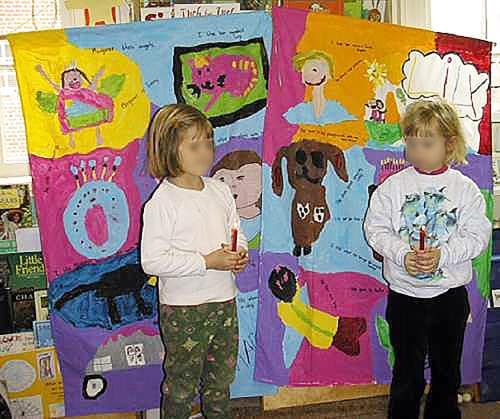
Two children receive the gifts their friends have made for them: flags with their favorite things in life painted on them.
In our class conversations, teachers demonstrated honoring multiple points of view, and the children learned to do the same. They learned to use language like, “in my opinion,” “I agree/disagree,” and “but what if…?” We wanted them to learn to have cognitive conflict without engaging in emotional conflict.
By privileging the child’s membership in the group, we hoped to see a group identity grow organically. Not only would every child belong to this group, but every child would feel as if she belonged as well.
In addition, we addressed exclusion directly. We set the expectation that children playing in a group would welcome a child who approached and asked to join them. To the children we said, “If they want to play, then find a way,” similar to Vivian Paley’s “You can’t say you can’t play” system. The parameters were:
- The approaching child asked what was happening and said she wanted to join.
- The group would articulate the premise of the game and suggested to the approaching child what she could “be” in the play.
- The approaching child could accept the invitation or negotiate another role, but she couldn’t just take over the play or change it without agreement from the group.
In setting up this system, we were supporting children’s efforts to join existing groups and heading off the exclusion-for-power tendency, so tempting when one group has something (belonging) that another does not.
We had many similar small systems set up for the sake of growing belonging and heading off othering. Unfortunately, these systems were part of the children’s lives for only that one year of Junior Kindergarten. Teachers in primary, elementary, middle, and upper schools did not choose to follow through. Still, parents of many former JK students report that their children retained the sense of belonging and social security they developed while in their first year at the school.
Often, the education system does not privilege belonging as a child’s birthright. It’s simply not addressed. In my opinion, typical schooling does not do enough to help children develop their natural dispositions toward relationship-building and sustaining. School curriculum does not include how to disagree with others without anger or hurt. If parents and teachers have never learned how either, they may not be available models for children. School is where children exist in community. So that is where the tribulations and joys of being in a group are likely to happen. Yet what is the plan for teaching children to live in community, with a place for everyone and no need to hurt others so we can feel better? “Lessons” and lectures and “I can” statements on the walls are not likely to help children feel the embrace of the community. But we can support a sense of belonging in our classrooms by considering every aspect of our days together and asking critically, as Lilian Katz has, “What is being learned here?” Is this interaction/system supporting belonging or othering? It matters, today more than ever.