
As I struggle to wrap my head around a profound sense of loss—loss of optimism, loss of a sense of safety, and loss of a (naïve?) sense that we are all in this together—I find myself looking for proof of connection. How can we muster the connection and sense of belonging that will allow us to resist the theft of our soul as a nation? Are we in the U.S. really so very different and separate from each other, or is that a convenient manipulation? A few weeks ago, I randomly encountered a particular blog post from a decade and a half ago. It was about a conversation among four- and five-year-old girls that emerged one day in the second week of school, and I was reminded about how often the thinking of young children can inspire us to think about problems in the adult world in a broader, more generative way. Revisiting this dialogue about the love life of trees inspires me now to think about connection from a new angle. I believe that every new angle is another opportunity to make sense of where we are at present. Here is the story, borrowed from the original private blog post.
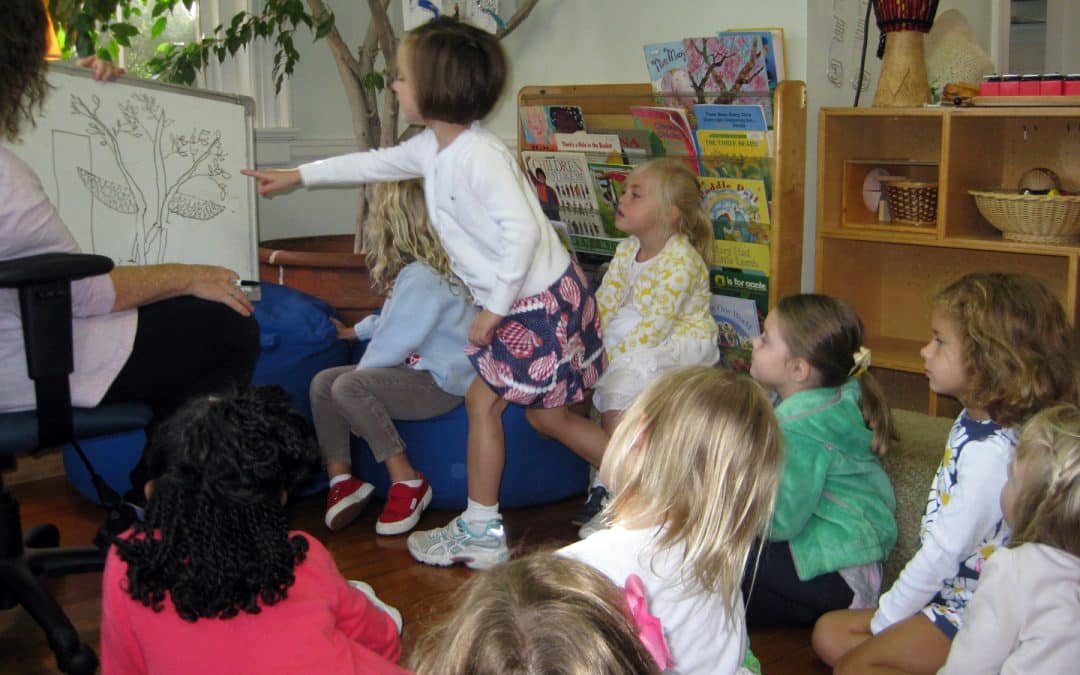
One September morning, when the children were new to each other, five-year-old Bailey and four-year-old Addisan and I were on a little walk to do an errand. Bailey looked around at the semi-wooded campus and mused, “I wonder if the trees talk?” My radar for brilliant wonderings lit up as we talked a bit about what a tree might say if it could talk. In that first spontaneous conversation, the girls discussed what trees would likely say if they could talk. The question was so intriguing that I took it to the children during our class meeting.
I didn’t know if the children would engage in dialogue or, if they did, how it would go so early in the year. However, in my experience, topics that invite imagination can be particularly compelling and worth pursuing. In fact, my earlier research demonstrated that imagination can serve as a portal to cognitive engagement and investigation when groups of children had previously not shown interest in sustained conversation. (See The Evolution of Courage). It was not unusual for the first class conversations children have for the co-construction of theory to arise out of magical thinking. As you will see, the children’s theories about trees had roots in both imagination and observation. For them, this was where thinking together about how the world works began.
The provocation: What would a tree say if it could talk?
Ella: I love you.
O-W: Who does a tree love?
Ella: Us!
Bailey: Maybe then he would get a girl tree.
Amelia R: Maybe a boy tree would get in love with a girl tree.
O-W: How would you know if a tree is a girl or a boy?
I did not pose questions with any particular inquiry in mind; these were honest questions I had about what the children were thinking.
Bailey: Because they [are] made out of trees, because you see the leaves that fall down? They’re gonna look like that. They’re gonna look plain. They’re gonna look like just like the branches.
Madigan: Evergreen! The girls are evergreen, and the boys are not.
O-W: The boys are the ones that lose their leaves? Is that what you think? (Yes)
Why are evergreen trees girls? My interpretation at the time was that Madigan’s theory was based on a dialogue between two ideas: 1. I know that boys and girls are different and 2. trees can be classified as evergreen or deciduous. Therefore, one type of tree must be female and the other male. Are the girls identifying with the evergreen trees, perhaps as “fancier” than trees that lose their leaves? In what other ways might they identify with the trees? Revisiting the conversation now, 15 years later, I wish I had asked for further clarification. Ah well, hindsight can be 20/20.
After a pause I asked again, “What do you think the trees would say if they could talk?
Grace: I think they would be saying hello.
Kathryn: They would shake their branch.
Tree language? Does this track indicate the children’s understanding about the differences between themselves and the trees? That is, “If they talk, they do not speak our language.”
Amelia R: It would probably take a branch off and then wave it to you.
Isabel: I think he would say to a girl tree for them to get married together.
O-W: What happens if two trees get married?
Isabel: They stay together forever.
Here everyone talked at once, which we call a “crowd.” To me, a crowd during conversation represents passion and deep engagement, and though we must emerge from the crowd in order to continue the dialogue, I always love those moments when the topic is so compelling that it becomes impossible for children to not say what they are thinking. And, in a way, this moment of apparent conflict became a moment of much-desired connection. Everyone experiences shared emotion around the idea in a crowd.
Turner: Cause trees just stick to the ground.
Bailey: When…finally the boy gets in love with the girl tree, he’s gonna fly up in the sky…because she’s so beautiful.
O-W: How would a tree do that?
Bailey: I don’t know.
Ella: Magically he could come up, and he could fly up in the air and kiss her and that way they could get together.
O-W: He could pull up his roots and fly up in the air? (Yes). Do trees have to be up in the air in order to get married?
Madigan: No! The girl tree has to be smaller because girls are smaller than boys.
O-W: Is that how you tell the difference?
Amelia R: That (the large ficus tree in our meeting space) is smaller and boys can be bigger.
O-W: So do you think this is a girl tree?
Many voices: Yes.
Kathryn: They are a double tree. Boy and girl.
O-W: So if you ever see a double tree, does that mean they are married? (Yes)
Kathryn: I saw a double tree in New York.
O-W: So are there lots of married trees, or just a few? (A few)
Lilly: You know what, I saw lots and lots and lots and lots of married trees in Baltimore.
Addisan: I think butterflies could give them their wings and they would “life” them off the ground, and they could fly.
O-W: Why do they need to fly?
Addisan: So they can get married.
O-W: Is that because of what Turner said, that their roots would be stuck in the ground otherwise? (Yes)
Several voices: But they need big wings. Birds! Hawks!
Bailey: How about the hawks stuck to the tree and they fly with their wings?
O-W: Oh, are you saying the hawks don’t give them their wings, they stay in the tree and fly and bring it up?
Ella: When a crow drops his feathers, the tree could pick them up, and he could fly.
O-W: You brought one of those feathers inside today, didn’t you?
Ella: Maybe I could take it (the feather) outside and I could flap some wind with it, so it can fly away.
Is Ella wondering if she could help the trees ascend by making wind with the feather? Yet more connection, child to tree.
Lilly: Know what? One time I saw a tree fly in Baltimore.
O-W: What was it flying with?
Lilly: Mmm, let me think. Oh, yeah. It was flying with wings.
O-W: Could you tell where it got the wings?
Lilly: Well, it kind of got the wings a long long time ago. Well, I did know, but my parents telled me.
Turner: They could try to fly, because I think that all birds are too tiny.
O-W: Too tiny? So the trees would have to do it by themselves?
Turner: Yeah. They could try.
Madigan: Cause a tree is the tallest thing in the world.
Grace: Giraffes are taller than trees.
Addisan: I know what’s taller. The Earth!
Amelia R: The sky!
Amelia G: A big, big, big whale.
Bailey: God!
Amelia R: God is the powerest thing here.
The blog post continued:
It can be helpful to follow conversations for the co-construction of theory with an invitation to children to make their ideas visible. In an attempt to make the children’s individual theories clear and known, we drew a collaborative representation of a tree with the wings the children thought trees should have in order to be married (at least until Turner pointed out that any kind of bird wing is no match for the size of a tree). In this kind of Shared Drawing session, the children direct the teacher as she draws to make their collective ideas visible. At first the children directed me to draw a rectangle…the beginning of the archetypal “lollipop tree.” But then someone noticed the many trunks of the ficus tree right there in the meeting space, and the children asked me to begin again. I wrote a “1” beside the first attempt, following our “study protocol,” (Oken-Wright, in press) and we started a new tree. Now the children’s directions took a more observational slant. Their directions focused not only on what they already “knew” about trees, but also on what they noticed about the tree in our meeting space. They noticed the placement of the leaves on the branches. They noticed the multiple trunks of the tree, and one of the children pointed out that the branches get thinner and thinner from trunk to end. After the children were satisfied that the tree was complete, they directed me to add eagle’s wings to it.
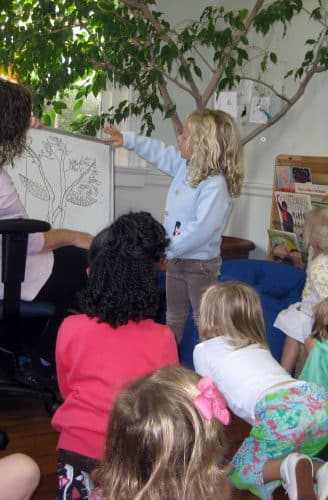
Revisiting this story now, I see that by inviting the children to engage in Shared Drawing of their theories about the love life of trees, I was facilitating the connection to trees they experienced by identifying with them and to each other by recognizing the differences between human and tree. The children’s understanding of trees, deepened through the collaborative drawing process, like our understanding of another person, leads to connection and a sense of belonging to the world.
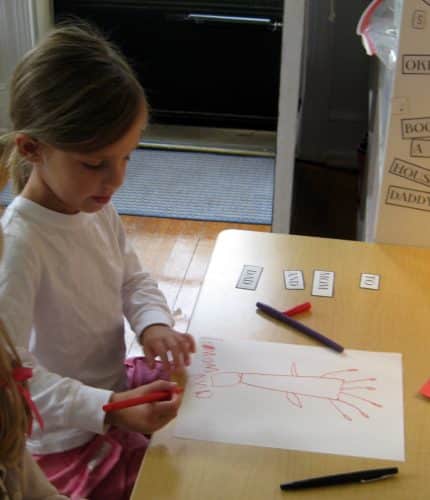
After meeting, Addisan chose to go to the message center to write a letter to her family. The letter was a drawing of a tree with wings. Was Addisan extending the connection? Was she trying to sustain and extend her sense of connection, child to tree to family?
Revisiting this old blog post inspired me to return to Peter Wohlleben’s book, The Hidden Life of Trees. In it, Wohlleben shows us that trees are all about connection. They communicate through their root systems and the fungi that are part of that system. Trees of the same species send out danger alerts that allow nearby trees to produce protective chemicals. “Mother” trees care for and even sacrifice themselves for their offspring. In essence, trees live in community. They belong to each other. In the children’s exploration of the ultimate (to them) connection – marriage– were they tuning into a visceral understanding of our destiny to connect? It would not surprise me. Long ago I learned not to underestimate children’s relationship with existence in ways adults no longer do. For example, when my daughter was three years old, after spinning joyfully in the backyard for a bit, she collapsed on her back onto a pile of mulch bags lying in the sun. Gazing at the sky and apropos of nothing obvious, she sighed, “I miss God.” I wondered if she could feel some innate connection fading. So profound are children’s connection to the world and their need for connection that, if we are listening in the deep way the educators of Reggio Emilia encourage us to, we can observe them representing connection through all kinds of media and across all kinds of investigations. If this connectedness is our natural state as human beings, if this is representative of the imperative nature of connection (and therefore belonging) to us all, how are we allowing the moral injury that those who seek to divide us intend? If belonging is a primal emotional need, how can we allow ourselves (or neighbors) to be othered?
I can’t help but think that in delving, however briefly, into the possibility of tree marriage, understanding tree communication, and ways in which they could identify with the trees, the children gifted us a metaphor about connection. May it serve us all.
References
Oken-Wright, P. Embracing Challenges in Early Childhood Education. Routledge. In press.
Wohlleben, P. (2015) The Hidden Life of Trees: What they Feel, How They Communicate. Greystone Books.
For further reading:
Goldhaber, J. “An Invitation to Participate in a Teacher Research Collaborative: Children and Trees in Relationship Reflecting Together” in Innovations: The International Reggio Exchange. Spring 2020.